BTC Pauses at $90,000 as Fed Sends Dovish Signals

bitcoinistPublished on 2025-12-09Last updated on 2025-12-09

Abstract

Bitcoin has stabilized around the $90,000 mark, supported by a softer tone from the Federal Reserve, creating a favorable macro environment for risk assets. While BTC solidifies its role as 'digital gold,' its limitations for payments and decentralized applications due to high fees and low throughput remain. This has increased interest in Layer 2 infrastructure solutions that leverage Bitcoin's security while overcoming its technical constraints. Amid this shift, Bitcoin Hyper emerges, aiming to be the first Bitcoin L2 integrating the Solana Virtual Machine (SVM). It focuses on practical applications like fast, low-fee BTC payments, DeFi protocols, staking services, and NFT platforms, targeting Solana-level speeds. The project's presale has raised over $29 million, indicating significant demand. Its native token, $HYPER, currently priced at $0.0134, has speculative potential for substantial growth if the protocol captures a share of the Bitcoin L2 market. Large investors are already accumulating the token, and a staking program with high APY is planned to incentivize holders post-launch. The combination of Bitcoin's price surge, a supportive macro backdrop, and the growing need for scalable Bitcoin infrastructure positions projects like Bitcoin Hyper to potentially bridge the gap between Bitcoin's security and modern decentralized application usability.

Bitcoin is back in the spotlight: after a rapid surge, the leading cryptocurrency has stabilized around the $90,000 mark, while the Fed's dovish rhetoric is easing pressure on risk assets. For long-term holders, this is a rare moment when the macroeconomic backdrop and the crypto market are finally moving in the same direction.

An important detail: at this price, Bitcoin remains primarily "digital gold." It excels at storing value but performs poorly as a foundational infrastructure for decentralized applications and mass payments. High fees and limited throughput don't disappear just because the price has gone up.

Simultaneously, interest is growing in infrastructure solutions that allow the use of Bitcoin's security without its technical limitations. Users are seeking fast BTC payments, DeFi protocols with clear yields, and gaming and NFT platforms that operate on a network with Bitcoin's reputation, rather than on obscure networks.

Against this backdrop, a shift in attention to new Layer 2 solutions seems logical. You've already seen a surge in interest in alternative networks and the expansion of features for standard crypto wallets. The next step is clear: a layer that removes Bitcoin's limitations while preserving its trust and security. This is where Bitcoin Hyper with the $HYPER token comes in.

BUY BITCOIN HYPER

Bitcoin Hyper Brings SVM Speed to the Bitcoin Ecosystem

Bitcoin Hyper announces the ambition to become the first-ever Layer 2 for Bitcoin with an integration of the Solana Virtual Machine. This signifies not a technical experiment, but a practical opportunity to use Bitcoin in the scenarios where everyone is used to seeing Solana: high-speed transactions, interactive applications, and active DeFi platforms.

The project focuses not on theory, but on user results: high-speed wrapped BTC payments with minimal fees, lending and exchange protocols, staking services, and the launch of NFT or gaming applications through a developer-friendly Rust toolset. Unlike solutions like Stacks, Bitcoin Hyper directly targets Solana-level speed and beyond.
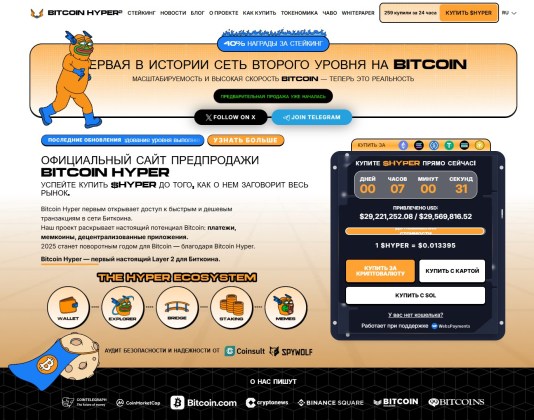
Market interest in these capabilities is already confirmed by the numbers: the presale raised $29,221,693.58 at a token price of $0.013395. For an infrastructure project launching during Bitcoin's historic rally and a softening Fed policy, this is a signal of not only retail but also strategic demand from participants thinking with a multi-year horizon.

$HYPER Potential

If Bitcoin Hyper captures just 5% of the Bitcoin Layer 2 solutions market, the $HYPER token could theoretically reach around $3.36, representing roughly a 250x growth from the current presale price of $0.013395. This is a speculative scenario, but it shows the scale of the potential effect with a moderate market share.

Major capital has already begun positioning itself in the token. Smart money isn't waiting for the final launch; they enter when the risk-reward ratio appears maximally skewed. According to on-chain tracking of large addresses, two well-funded crypto investors collectively purchased $396,000 worth of tokens, with the largest single transaction reaching $53,000 recently and being recorded on the blockchain.

An additional layer of interest is formed by the promised staking program with an elevated annual yield, available immediately after token generation and a seven-day lock-up period for presale participants. Rewards are distributed for community activity and participation in protocol governance, making $HYPER not just a speculative asset, but a working element of the ecosystem.

The final point is simple: the Bitcoin market is at new highs, regulators are softening their tone, and the infrastructure deficit around Bitcoin is only growing. At this point in the cycle, solutions like Bitcoin Hyper have a chance to become the layer that connects the reliability of "digital gold" with the convenience of modern DeFi and applications.

Related Questions

QWhat is the current price level that Bitcoin has stabilized at according to the article?

ABitcoin has stabilized around the $90,000 mark.

QWhat is the name of the new project and its token that aims to bring Solana-like speed to the Bitcoin ecosystem?

AThe project is called Bitcoin Hyper and its token is $HYPER.

QWhat specific technology does Bitcoin Hyper integrate to enable high-speed transactions and applications?

ABitcoin Hyper integrates the Solana Virtual Machine (SVM).

QHow much was raised in the presale for the $HYPER token, and at what price?

AThe presale raised $29,221,693.58 at a token price of $0.013395.

QWhat is the speculative potential price target for the $HYPER token if it captures 5% of the Bitcoin L2 market?

AThe speculative price target is approximately $3.36, representing a 250x growth from the presale price.

Related Reads

The New Frontier of Privacy Coins: Technology, Prevention, and Regulatory Game

Privacy coins are at a critical juncture, shaped by technological evolution, regulatory pressure, and judicial decisions. In 2024–2025, court rulings, law enforcement actions, and technical adjustments are redefining the boundaries of this sector. Key developments include debates over whether decentralized mixing tools constitute sanctionable property, cross-border crackdowns on anonymous transaction services in Europe and the U.S., and privacy-focused projects adopting more compliant technical designs. Judicially, U.S. courts have issued influential rulings questioning whether immutable smart contracts fit traditional legal frameworks. Meanwhile, European authorities continue to target mixing services accused of facilitating money laundering. Technologically, some privacy projects are incorporating optional privacy features, flexible fee mechanisms, and improved audit interfaces to enhance usability and reduce regulatory friction. Macro-trends show countries advancing comprehensive crypto regulatory frameworks covering custody, trading, stablecoins, and anti-money laundering (AML) standards. Regulatory bodies increasingly demand that high-privacy tools provide verifiable audit trails or compliance-friendly modes to access legal financial services. Looking ahead, three main trajectories are emerging: continued legal clarification around smart contracts and mixer liabilities, a shift in privacy protocols from absolute anonymity toward optional privacy with auditability, and a market reassessment of the regulatory risk associated with privacy assets. This is causing a strategic split within the industry—some communities insist on strong privacy for niche demands, while others pursue “compliance-friendly privacy” models like enterprise-grade confidential transactions or auditable privacy pools. In essence, privacy coins are transitioning from pursuing maximum anonymity to seeking sustainable existence within regulatory boundaries. Future judicial rulings, policies, and protocol upgrades will determine which projects survive market and legal pressures. Those offering meaningful privacy while maintaining legal compliance are most likely to endure.

cointelegraph_中文8m ago

The New Frontier of Privacy Coins: Technology, Prevention, and Regulatory Game

cointelegraph_中文8m ago

Champion! Huobi HTX Tops the Industry with $583.7M Net Asset Inflow Over the Past 30 Days

In the competitive crypto industry, fund flows reveal true user trust. According to Defillama data on December 5, Huobi HTX recorded a net inflow of $583.7M over the past 30 days, ranking first among all centralized exchanges (CEXs). This reflects growing user confidence in the platform’s security, transparency, and product offerings. Huobi HTX has maintained steady growth in total assets and spot trading volume, forming a positive cycle of asset safety, user growth, and capital inflow. Key factors behind this performance include enhanced asset proof mechanisms—with 38 consecutive months of published Merkle Tree Proof of Reserves (PoR) and 100%+ reserve ratios for major assets—alongside improved C2C trading features such as a "100% compensation" policy and a streamlined user experience. The platform’s earn products, including Huobi Earn, also saw significant growth, with increases in both user participation and asset deposits for tokens like USDD, ETH, and TRX. Users are increasingly choosing Huobi HTX for its reliable yields, ease of use, and strong security measures during market volatility. As a long-established exchange founded in 2013, Huobi HTX has strengthened its compliance and risk management frameworks, reinforcing its reputation for safety and transparency. The net inflow milestone underscores its position as a trusted platform where users choose to securely store and grow their digital assets.

深潮29m ago

Champion! Huobi HTX Tops the Industry with $583.7M Net Asset Inflow Over the Past 30 Days

深潮29m ago

From 'Stablecoin First Stock' to 'Ankle Cut' in Stock Price: Why Circle Quickly Fell from the Spotlight into a Revaluation Cycle

From "Stablecoin Unicorn" to "Ankle-Cut" Stock Price: Why Circle Quickly Fell from Its Peak into a Revaluation Cycle Circle, the issuer of the USDC stablecoin, experienced a dramatic stock price decline shortly after its IPO in June, dropping from an initial peak of around $260 to approximately $88. This reflects a broader market shift from hype-driven optimism to a more rational reassessment of the stablecoin industry. Multiple factors contributed to this sharp correction. Initially, the stock was significantly overvalued due to market enthusiasm for the "first stablecoin stock" and the high-interest environment that boosted the appeal of its reserve-backed revenue model. As early investors took profits and sentiment cooled, a price correction was inevitable. Increased competition is also pressuring Circle. While USDC is the world's second-largest dollar stablecoin, it faces growing challenges from new stablecoin projects and digital dollar initiatives from traditional financial institutions. The sector is shifting from an oligopoly to intense competition, raising investor concerns about USDC's future growth certainty. Furthermore, macroeconomic interest rate trends pose a fundamental risk to Circle's business model. Its core revenue comes from interest earned on the cash and short-term U.S. Treasuries backing USDC. Expectations that the Federal Reserve may begin a rate-cutting cycle could directly compress this income. Rising operational and distribution costs further squeeze profitability. Analysts hold divergent views on Circle's future. Firms like Mizuho have turned bullish, upgrading the stock and suggesting the sell-off related to its post-IPO lockup expiration may have created a buying opportunity. They point to USDC's continued adoption by mainstream financial institutions. Conversely, analysts at firms like Susquehanna remain pessimistic, maintaining an "Underperform" rating. They warn that lower future interest rates and potential underperformance in USDC growth could continue to pressure the stock price and have lowered their price target. The upcoming end of the post-IPO lockup period, which restricts insiders from selling shares, has added near-term selling pressure, but this is viewed by some as a temporary overhang. Circle's recent Q3 earnings report, which beat expectations for both revenue and profit, shows that these fundamental concerns have not yet materialized, leaving the company's trajectory highly dependent on future interest rates and its ability to maintain and grow USDC's market share amidst fierce competition.

cointelegraph_中文30m ago

From 'Stablecoin First Stock' to 'Ankle Cut' in Stock Price: Why Circle Quickly Fell from the Spotlight into a Revaluation Cycle

cointelegraph_中文30m ago

Trading

Spot
Futures
活动图片